The Emu War: When Australia Sent Machine Guns Against Birds, and Lost
In 1932, Australian soldiers with Lewis guns went to war with 20,000 emus in Western Australia. The emus won. Here is what really happened.
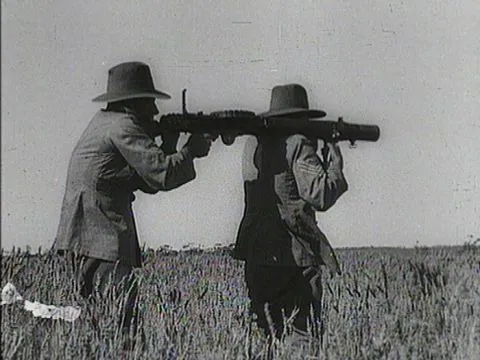

- Emus in the districtabout 20,000
- Rounds of ammunition usedclose to 10,000
- Emus killed (army claim)986
- Soldiers sent3
Figures from Major Meredith's report and contemporary press. The emu count is an estimate.
In November 1932, the Australian Army sent soldiers armed with machine guns into the wheat fields of Western Australia. Their enemy was a flock of around 20,000 emus.
A month later the soldiers went home. The emus were still there.
It sounds like a joke, but the “Emu War” was a real military operation, approved by the federal Minister of Defence and reported in newspapers around the world. This is how it went so wrong.
Why farmers wanted machine guns
The story starts with the end of the First World War. Australia gave thousands of returning soldiers land to farm, much of it in the dry wheat belt of Western Australia. It was hard country, and many of these “soldier settlers” were already struggling.
Then the Great Depression hit. Wheat prices collapsed, and help the government had promised never fully arrived.
In late 1932, the emus came. After their breeding season, emus move inland in search of food and water. The cleared farmland, with its crops and water supplies, was perfect for them. Around 20,000 birds poured into the district around Campion and Walgoolan. They ate and trampled the wheat, and they broke fences, which let rabbits in to finish the job.
The farmers were veterans. They knew what a machine gun could do. So they sent a group to the Minister of Defence, Sir George Pearce, and asked for some.
Pearce said yes. The army would provide the guns and the gunners. The Western Australian government would pay for transport, and the farmers would provide food, housing and ammunition costs.
The army arrives
The commander was Major G. P. W. Meredith of the Royal Australian Artillery. He brought two soldiers, Sergeant S. McMurray and Gunner J. O’Halloran, plus two Lewis guns and 10,000 rounds of ammunition. The Lewis gun was the same light machine gun used by Australian troops in the First World War.
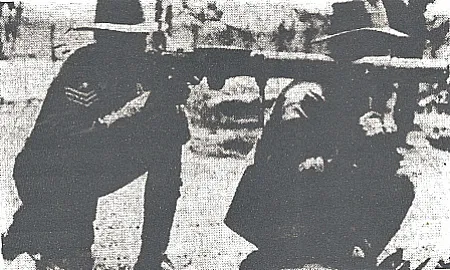
Sergeant McMurray and Gunner O’Halloran, as printed in a 1932 newspaper. Public domain, via Wikimedia Commons.

Rain delayed the start. When the operation finally began on 2 November 1932, the emus did something nobody had planned for. They scattered.
On the first day, local farmers tried to herd a group of about 50 emus toward the guns. The birds split into small groups and ran out of range. Two days later, the soldiers set up an ambush near a dam where about 1,000 emus came to drink. They opened fire at close range. After only a dozen or so birds fell, the gun jammed, and the rest of the flock ran off.
Emus 1, Army 0
Meredith tried a new tactic. He mounted a Lewis gun on the back of a truck and chased the birds across the paddocks.
It didn’t work. Emus can run at around 50 kilometres per hour, faster than the truck could manage on rough farmland. The ride was so bumpy that the gunner could not aim.
Within a week, the soldiers had fired around 2,500 rounds. Reports of how many emus they had killed varied wildly. The newspapers were having fun, and politicians in Canberra asked awkward questions. On 8 November, the minister withdrew the soldiers.
Round two
The farmers did not give up. They kept asking for help, and the army sent Meredith back on 13 November.
This time the results were better. By early December, the soldiers were killing roughly 100 emus a week. The operation finally ended on 10 December 1932.
In his report, Meredith claimed 986 kills using close to 10,000 rounds of ammunition. That is about ten bullets for every bird. He also believed around 2,500 wounded emus died later, though nobody could check.
Meredith was impressed by his enemy. He told a newspaper that if the army had a division with the bullet-carrying capacity of these birds, “it would face any army in the world. They can face machine guns with the invulnerability of tanks.”
Who really won?
Most people say the emus won, and it is hard to argue. The army withdrew twice, used thousands of rounds, and left a large emu population behind.
Farmers asked for military help again in 1934, 1943 and 1948. Each time the government said no. Instead, Western Australia relied on bounties for shot emus and on long fences to keep the birds out of farmland. Over the following years, the bounty system killed far more emus than the soldiers ever did.
Today the emu is still doing fine. It is one of the two animals holding up Australia’s coat of arms, next to the kangaroo.
Fact or myth?
1The Emu War was a real military operation approved by Australia's Minister of Defence.
Sir George Pearce agreed to send soldiers with two Lewis guns in 1932.
2Mounting a machine gun on a truck finally let the soldiers catch the emus.
The emus outran the truck on rough ground, and the ride was too bumpy for the gunner to aim.
3After the Emu War, farmers relied on bounties and long fences instead of the army.
The government refused further military help in 1934, 1943 and 1948. Bounties killed far more emus than the soldiers did.
Sources
- Encyclopaedia Britannica, “Emu War”
- Sydney Harbour Federation Trust, “Brigadier Gwynydd Meredith”
- Scientific American (blog), “The Great Emu War: In which some large, flightless birds unwittingly foiled the Australian Army”
- Mental Floss, “When Australia Went to War With Its Emus”
- Murray Johnson, “‘Feathered foes’: soldier settlers and Western Australia's ‘Emu War’ of 1932,” Journal of Australian Studies 30, no. 88 (2006)
- Wikipedia, “Emu War” (timeline and contemporary press quotes)
Spotted a mistake? Tell us and we will correct it.